
The Ultimate Guide to SUP Boarding for Beginners
Master your stance balance, streamline paddle strokes, and explore calm lakes, coastal bays, and tranquil rivers with confidence.
 Beginner Essentials
Stepping Onto Open Water with Balance and Rhythm
Stand-up paddleboarding offers an accessible entry point into watersports, engaging your core and legs while offering scenic tranquility. With the right board width, centered foot positioning, and efficient paddle cadence, any newcomer can glide smoothly across lakes and calm bays on day one.
Article Chapters & Advice
Launching and Finding Your Center Balance
Starting on calm, flat water gives you immediate control without combating waves or current chop. Wade out until the board floats freely in knee-deep water so the center fin clears submerged rocks or sand. Position your knees over the center carry handle, which acts as the natural pivot axis of the board. Take several gentle paddle strokes while kneeling to get a feel for how the board responds under momentum before standing up.
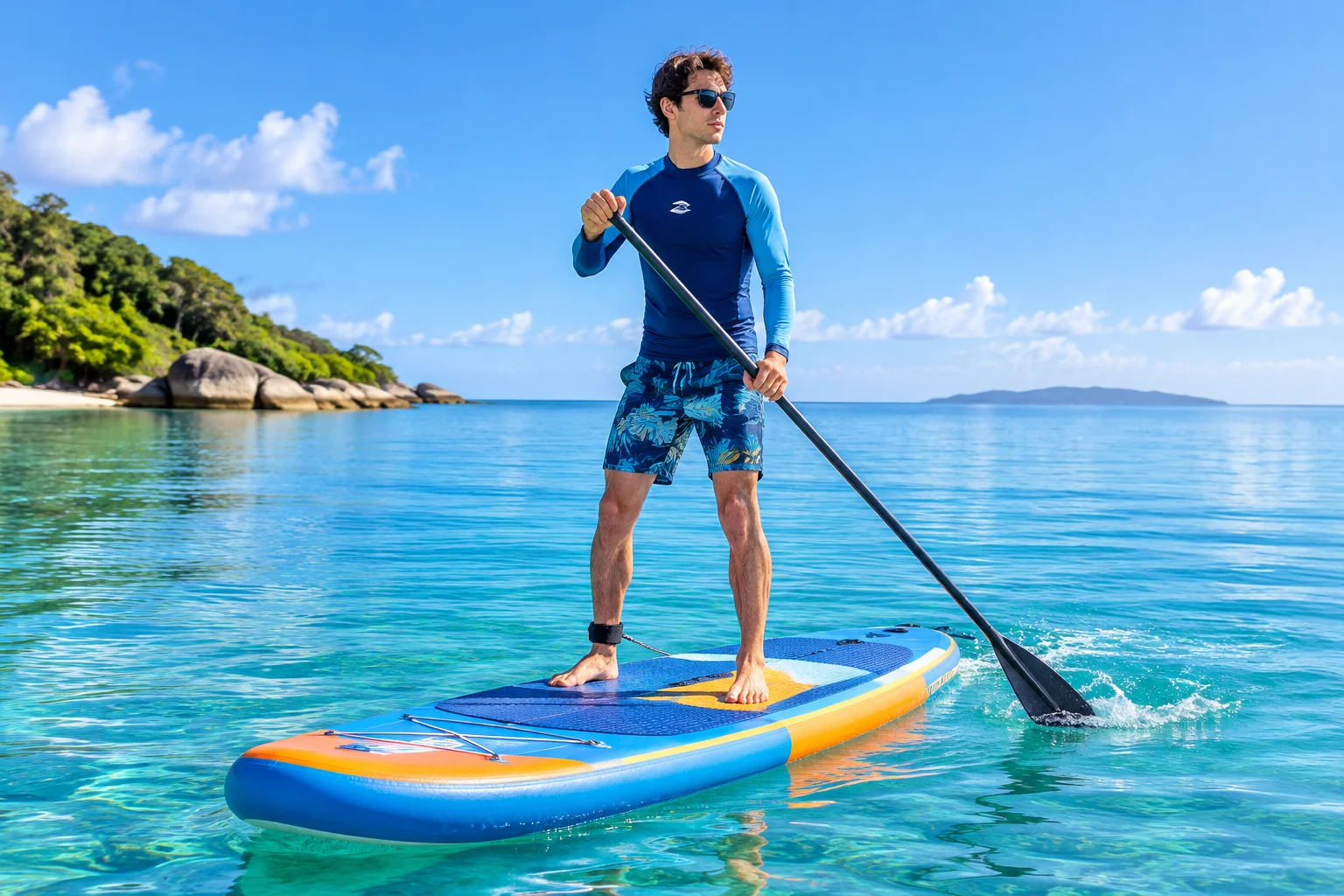
When ready to stand, keep your paddle perpendicular across the deck in front of you. Place one foot flat where your knee rested, then quickly plant the other foot parallel to it, keeping them hip-width apart and toes pointed forward. Push smoothly upward through your heels, keeping your knees slightly bent to absorb ripples. Avoid staring down at your toes; looking toward the horizon immediately locks your inner ear balance and stabilizes your posture.
Mastering the Forward Stroke & Efficient Turning
True paddling power comes from your torso and core muscles, not just your arms. Hold the top grip with one hand while the lower hand grips the shaft shoulder-width below. The paddle blade should angle forward away from you as it enters the water.
- Reach the blade fully forward and submerge it completely beside the rail before pulling backward.
- Engage your core to drive the stroke back toward your ankles, lifting the blade out before it passes your feet.
- Keep your arms relatively straight, using rotational movement from your abdominal muscles to generate forward glide.
- Execute a wide sweeping stroke outward in a half-circle arc from nose to tail to rotate the board swiftly.
Switch paddling sides every four to six strokes to maintain a straight trajectory. When swapping hands, slide the lower hand to the top T-grip and place the other hand on the shaft in one fluid motion without interrupting board momentum.
Related Adventures & Guides
Ready to test these techniques on open water?
Explore our range of heavy-duty inflatable boats, SUP boards, carbon paddles, and electric marine motors.
Leave a Comment or Question